
Home > News > Company News
Luoyang, Henan — August 13, 2026 — A three-person delegation from a Europe district heating customer visited the Luoyang manufacturing plant of Sanjie Energy Conservation New Material Co., Ltd. for an on-site audit. The team toured the showroom, the in-house laboratory and the full pre-insulated pipe production line, and closed with a technical session in which the delegation focused heavily on two critical technical topics: closed-cell rate and field joint welding.Following the audit, the customer moved the project into the sample confirmation stage.
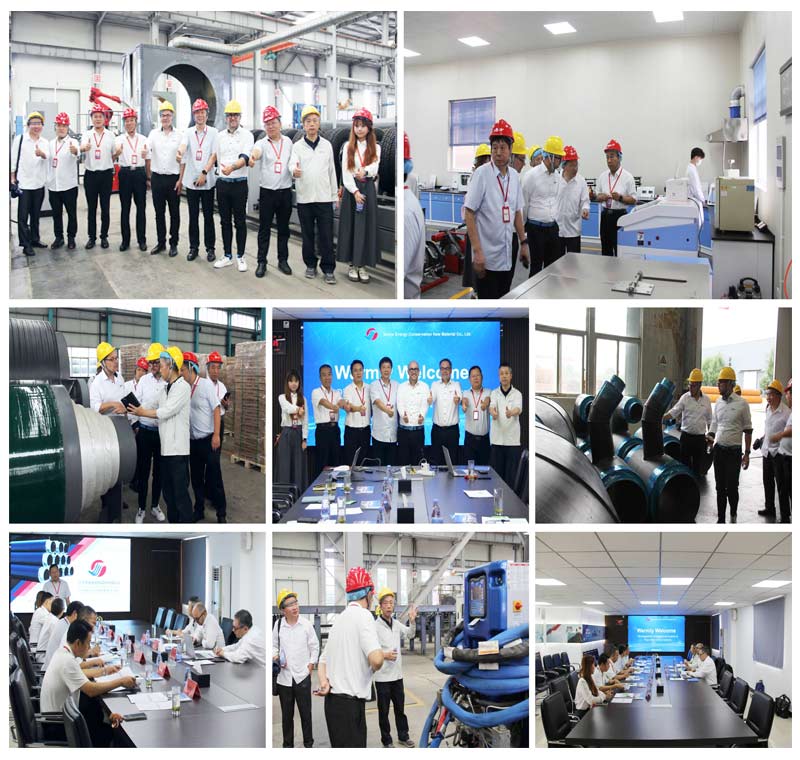
The visit reflects a pattern that has become routine for European district heating buyers: before a pre-insulated pipe supplier is written into a tender, an engineer travels out to confirm that the plant behind the catalogue actually builds what the standard requires.
Across Europe, pre-insulated pipe for directly buried hot water networks is specified against EN 253, with EN 13941-1 for design and installation and EN 489 for the joints made in the field. That puts the weight on the factory rather than the sales office: bonding quality, foam structure and casing integrity cannot be inspected into a pipe after the fact, which is why a plant audit is the cheapest risk control a utility or EPC contractor can buy for a 30-year buried asset.
Showroom, laboratory, production line:The three-person delegation conducted their site review sequentially in sequence:
- Showroom — the first stop, where the display covers pre-insulated direct buried pipe and insulated pipe fittings, together with the patents and awards the company has earned and the story of the plant's 28 years of growth.
- In-house laboratory — where the plant's own testing and quality control happens, and how laboratory results feed back into production rather than sitting in a report folder.
- Full pre-insulated pipe production line — the delegation followed the manufacturing process end to end, from steel service pipe preparation through polyurethane insulation to the polyethylene outer casing, with in-line inspection points throughout the production flow
- Workshop safety management, which is posted and enforced on the shop floor alongside the line.
Closed-cell rate and joint welding: the two questions that shaped the session
A plant audit is usually decided by the two or three questions the visiting engineer refuses to let go of. In this case they were closed-cell rate and joint welding — which is exactly where a district heating specification is most likely to be won or lost.
Closed-cell rate
Closed-cell rate is the share of foam cells in the rigid polyurethane insulation that remain closed rather than open. It drives two things a district heating operator cares about: how much heat the pipe loses, and how long the foam resists moisture uptake, because an open-cell structure lets water penetrate and degrade thermal performance over the life of the network.
The relevant point for a buyer is not the number in a brochure — it is how the plant proves it, batch after batch. In Sanjie's case, closed-cell rate sits among the key performance indicators covered by type-test reports issued by national testing centres, alongside thermal conductivity and compressive strength. Sanjie states that materials can be spot-checked and re-tested by the buyer's own laboratory, and that third-party testing and acceptance inspection can be arranged.
Joint welding
On a buried network the pipe lengths are the controlled part; the joints are where a specification meets a site crew. EN 489 is the standard that governs bonded joint assemblies for directly buried hot water networks — fusion welding of the steel service pipe, joining of the casing ends with a joint casing, and the thermal insulation that fills the joint. Switzerland adopts it nationally as SN EN 489, which is why a Europe buyer questions jointing in this much detail.
The questions here are practical: how the joint interface is designed for field work, how welding quality is controlled, and what the installing crew is given to work with. Sanjie's position is that joints are standardised with optimised interfaces to shorten installation time, and that customers receive installation guide videos and technical manuals, with engineers available remotely or on site during construction.
- Type-test reports issued by national testing centres, covering key performance indicators such as thermal conductivity, closed-cell rate and compressive strength.
- Certificates and qualification documents — business licence, production permits, system certificates and certificates of conformity — the set typically requested in tender response documents.
- Project references for comparable district heating and municipal networks, so the visiting team could judge process maturity rather than a single sample.
- Leak-detection provision — the alarm-wire system built into the insulated pipe, which turns post-installation fault-finding from blind excavation into precise positioning.
Next step: the project moves to sample confirmation
Audit complete, the project did not stop at a plant visit. The customer's decision was to move into sample confirmation — the stage at which a district heating buyer verifies the physical product against the specification before any volume order is placed.
In practice, that stage is where the questions raised on the site visit have to be answered in material rather than in conversation: dimensional and construction checks on a pipe sample, verification of the insulation and casing against the declared values, and — for the jointing questions raised during the audit — confirmation that the jointing set-up and welding procedure match what the installing crew will actually do on site.
Sanjie states that sample support is provided, that samples can be spot-checked and re-tested by the buyer's own laboratory, and that third-party testing and acceptance inspection can be arranged.
FAQ
What happens after a factory audit of Sanjie's plant?
An audit is normally followed by a technical review and then sample confirmation, where the buyer verifies the physical pipe, insulation and jointing against the specification before volume ordering. Sanjie provides sample support and states that samples can be spot-checked and re-tested by the buyer's own laboratory, with third-party testing and acceptance inspection arranged on request.
How is closed-cell rate verified on Sanjie's pre-insulated pipe?
Closed-cell rate is one of the key performance indicators covered by type-test reports issued by national testing centres, alongside thermal conductivity and compressive strength. Sanjie states that materials can be spot-checked and re-tested by the buyer's own laboratory, and that third-party testing and acceptance inspection can be arranged.
How are joints made on Sanjie pre-insulated pipe?
Field joints on directly buried hot water networks are governed by EN 489 (adopted in Switzerland as SN EN 489): fusion welding of the steel service pipe, closing the casing ends with a joint casing, and insulating the joint. Sanjie standardises the joint interface to shorten installation time and supports installing crews with guide videos, technical manuals and engineers available remotely or on site.
Can European buyers visit and audit the Sanjie factory in person?
Yes. Sanjie factory visits and audits at its Luoyang plant, Henan Province — showroom, laboratory and production line. Requests can be made via the contact page.
Does Sanjie manufacture pre-insulated pipe to EN 253?
Yes. Sanjie's prefab direct buried insulated pipe range is offered against the EN 253 district heating specification, in sizes from DN20 to DN1600. Performance documentation is available as type-test reports from national testing centres.
What district heating pipe sizes does Sanjie supply?
Four pre-insulated pipe families cover district heating work: prefab direct buried insulated pipe (EN 253), PE-RT II pre-insulated pipe, pre-insulated steam pipe, and pre-insulated hot water pipe for above-ground or pipe-gallery (utility tunnel) installation. The direct buried range runs from DN20 to DN1600 for secondary networks with a 50-year design life.
What is the delivery lead time for European orders?
Sanjie states a 7–15 day delivery lead time, supported by 40+ production lines across 4 factories, stock of 10 km for all specifications, and a stated 100% on-time delivery rate.
What documentation can Sanjie provide for a district heating tender?
Business licence, production permits, system certificates, certificates of conformity, national centre type-test reports, and as-built documentation. Sanjie also supports third-party testing and acceptance inspection.
 Hot News

Sanjie specialized in developing and manufacturing pipeline system, the main products contain pre-insulated pipes, HDPE pipes, pipe fittings, insulation materials ect. offering customization technology support and product solutions.
No.02 Jianye Road, Luoyang Airport Industrial Agglomeration Area,Henan,China
Copyright © Henan Sanjie Pipe Mart Co., Ltd. All Rights Reserved Privacy Policy
 EN


