
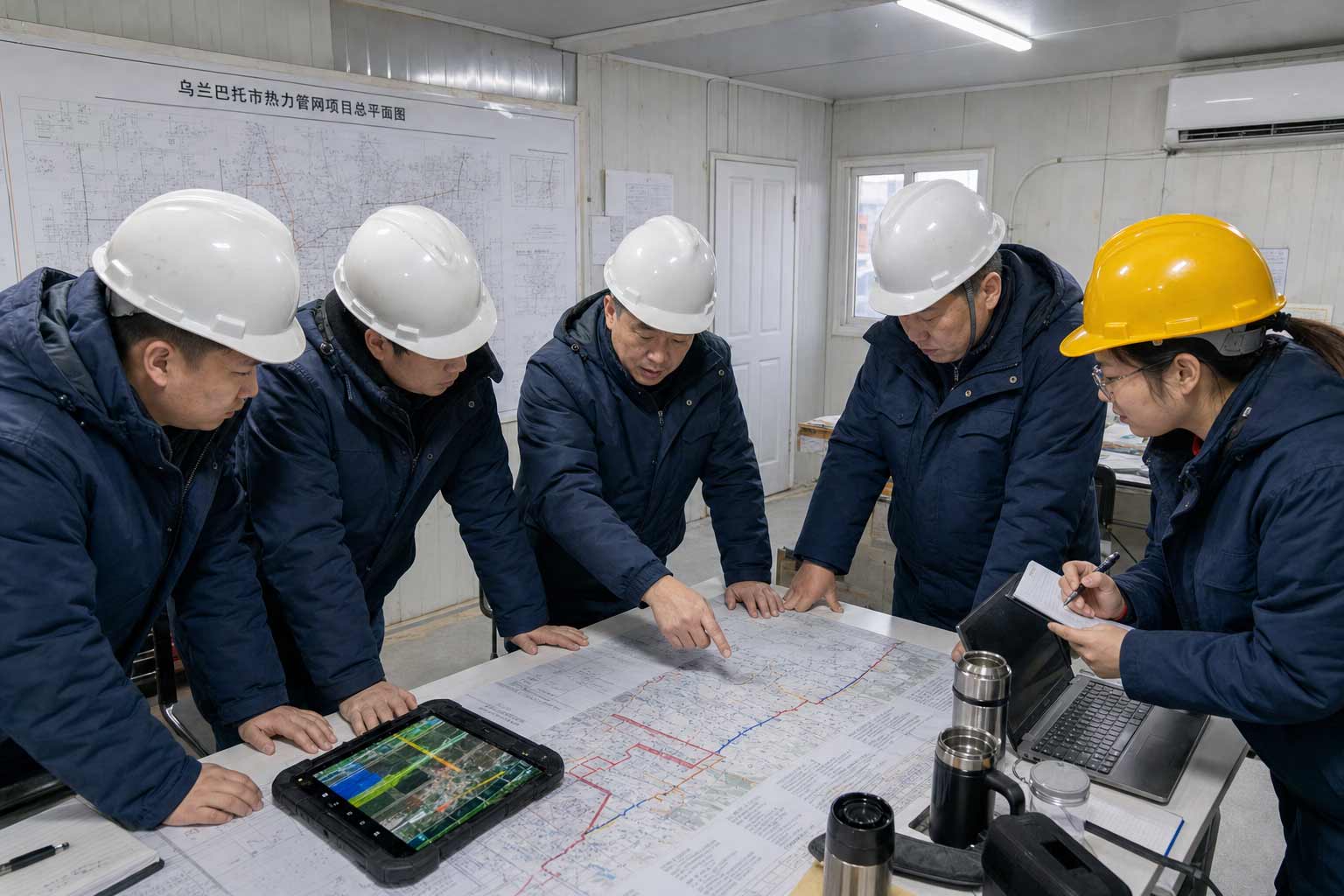
How to Prevent Brittle Casing Fracture & Joint Rupture in -40°C Permafrost District Heating? Engineering Lessons from 4 Technical Drawing Revisions for Ulaanbaatar's Mainline
1. Executive Summary & Project Snapshot
| Project Attribute | Engineering Fact & Verified Parameter (Standard-Backed) |
| Project Location | Ulaanbaatar, Mongolia |
| Application Scenario | Municipal District Heating Transmission Mainline in Deep Permafrost (-40°C Extreme Siberian Climate) |
| Operating Medium & Temp | High-temperature pressurized hot water; Supply: 115°C~130°C, Return: 70°C; Continuous design operating temperature 130°C, service‑life calculation per EN 13941 |
| Design & Test Pressure | Design Pressure: 2.5 MPa (25 bar); Hydrostatic Factory Test: >=3.75 MPa (1.5 x Design Pressure per EN 253 / EN 13941) |
| Carrier Steel Pipe | Seamless Steel Pipe (EN 10216-2 P235GH / ASTM A106 Gr.B) for branch lines; LSAW Welded Pipe (EN 10217-2 / EN 10217-5 P235GH / API 5L Gr.B PSL2) for mainline (DN500); Shot‑blasted to Sa 2.5 (ISO 8501‑1); surface anchor profile 40‑80 μm (ISO 8503‑2) |
| Insulation Specification | High-temperature rigid PUR foam, core density >=60 kg/m3 (ISO 845); Radial compressive strength >=0.30 MPa at 10% relative deformation (EN 253 clause 5.3.3); Axial shear strength >=0.12 MPa at 23°C and >=0.08 MPa at 140°C (EN 253 clause 5.4.1.4); Thermal conductivity lambda <=0.029 W/(mK) at 50°C (EN 253:2019+A1:2024) |
| Outer Casing Specification | High-Density Polyethylene casing (HDPE), base resin density >=944 kg/m3, compound density >=955 kg/m3 (EN 253 clause 4.2.1); Standard elongation at break >=350% at 23°C; Environmental Stress Crack Resistance (ESCR) > 1000h (ASTM D1693 condition B); Verified crack-free under extreme cold impact testing at -40°C |
| Supply Quantity | 3,486+ meters (DN500/630 & DN400/560) + custom prefabricated fittings |
| Delivery & Customs | Cross-border multimodal truck transit via Erenhot / Zamiin-Uud border port; First batch dispatched in 21 calendar days |
| Verified Engineering Result | Full‑scope ultrasonic testing (UT) on all welds, with radiographic testing (RT) performed for spot verification; high weld acceptance rate after qualified repair where needed|
2. The Dilemma: Extreme Challenges in Sub-Zero Permafrost Heating
①. Brittle Casing Shattering in Permafrost:
Ulaanbaatar’s frost line penetrates deeper than 2.8 meters. Standard-grade HDPE outer casings lose impact ductile toughness below -20°C. Seasonal frost-heave and rocky permafrost ground settlement cause catastrophic brittle cracking, allowing groundwater to saturate the open PUR cells, destroying insulation performance and causing accelerated external corrosion of the steel core.
②. Severe Axial Thermal Stress & Anchorage Overload (Delta T > 110°C):
In district heating systems operating between cold shutdown conditions (around 0°C~10°C in buried trenches) and peak supply temperatures of 130°C, the temperature differential exceeds 110°C~120°C. For fully restrained straight runs of DN500 carbon steel pipe, constrained thermal expansion generates axial compressive forces exceeding hundreds of tons (F = E A alpha Delta_T (generating approx. 300 to 450 metric tons of thrust)). Without precise stress analysis, these forces will buckle pipelines and tear apart concrete anchor blocks.
③. Missing Archives & Narrow Construction Window:
The client lacked precise underground utility maps for legacy 1970s heating networks. With the construction window strictly limited to May–September, any design mistake or delivery delay would trigger a catastrophic heating crisis before winter freeze-up.
3. The Sanjie Engineered Solution & 4 Drawing Revisions
Rev 1.0 (Hydraulic Sizing & Velocity Optimization): Corrected initial pressure drop bottlenecks by sizing the mainline diameter to DN500 (20") while keeping hot water velocity within the optimal 1.5~2.2 m/s range.
Rev 2.0 (Material & Siberian-Grade Hardening): Upgraded outer casing to Cold-Resistant Modified PE100 (ESCR > 1000 hours, tested crack-free under -40°C low-temperature impact). Formulated PUR insulation with thermal conductivity lambda <= 0.029 W/(mK) conforming to EN 253:2019+A1:2024.
Rev 3.0 (Thermal Stress Control & Anchor Engineering): Integrated axial bellows expansion joints and finite-element designed reinforced thrust anchor blocks (complying with EN 13941 design rules) to safely absorb longitudinal expansion while preventing pipeline fatigue yielding.
Rev 4.0 (3D Obstacle Bypass & Custom Fabrication): Based on real-time trench excavation 3D scans, Sanjie custom-prefabricated non-standard offset elbows and transition fittings (conforming to EN 448) in our factory, completely eliminating difficult on-site field cutting and welding under sub-zero conditions.
Emergency Production & Green Channel Logistics: Mobilized continuous foaming lines to produce the initial mainline section within 10 days, securing priority cross-border customs clearance via Erenhot to arrive on site before ground freezing.
4. Measurable Value & Municipal Reliability
Zero Service Interruption: Maintained smooth municipal heating across Ulaanbaatar through brutal winter seasons (-42°C) with zero leakage, zero casing cracks, and zero heat complaints.
100% First-Pass Weld Inspection: Full MTC 3.1 mill test certificates, Full‑scope ultrasonic testing (UT) on all welds, with radiographic testing (RT) performed for spot verification; high weld acceptance rate after qualified repair where needed.
5. RFQ Checklist for District Heating Contractors
1. `Carrier Pipe Specification: Seamless or Welded `
2. `Operating Temperature: Supply Water / Return Water (°C; e.g. 130°C / 70°C)`
3. `Design Pressure: (1.6 MPa, 2.5 MPa, or custom per EN 13941)`
4. `Burial Depth to Top of Casing & Local Frost Line Depth (m)`
5. `Fitting List: Expansion Bellows, Fixed Thrust Anchors, Directional Elbows per EN 448`

Sanjie specialized in developing and manufacturing pipeline system, the main products contain pre-insulated pipes, HDPE pipes, pipe fittings, insulation materials ect. offering customization technology support and product solutions.
No.02 Jianye Road, Luoyang Airport Industrial Agglomeration Area,Henan,China
Copyright © Henan Sanjie Pipe Mart Co., Ltd. All Rights Reserved Privacy Policy
 EN
